Your HVAC business is solid. Your technicians are skilled, and your customers love the work you do. But here’s the real problem: the phone isn’t ringing enough.
You’re not alone. HVAC contractors across Sarasota wake up wondering how to fill the pipeline with consistent, quality leads. Between the seasonal swings, the competitive local market, and the noise of every other contractor trying to grab attention, it feels impossible to break through.
The truth? It’s not impossible. It’s just that most HVAC business owners are doing lead generation the hard way—or worse, not doing it at all.
This article breaks down the exact strategies that actually work for getting more HVAC leads in Sarasota. We’re talking about field-tested tactics, not theory. Every method here has been proven to drive real calls and real bookings for contractors who implement it.
What you’ll learn here goes beyond the basics. You’ll get into the mechanics of what makes your business show up in search results, how to get customers to leave reviews that actually convert, why some contractors are drowning in calls while others sit idle, and the step-by-step systems to attract high-intent homeowners ready to book.
We’ve researched the top-performing HVAC lead generation strategies, analyzed what’s working in 2025, and mapped out exactly how to adapt these tactics for your Sarasota market. Let’s start filling that pipeline.
Table of Contents
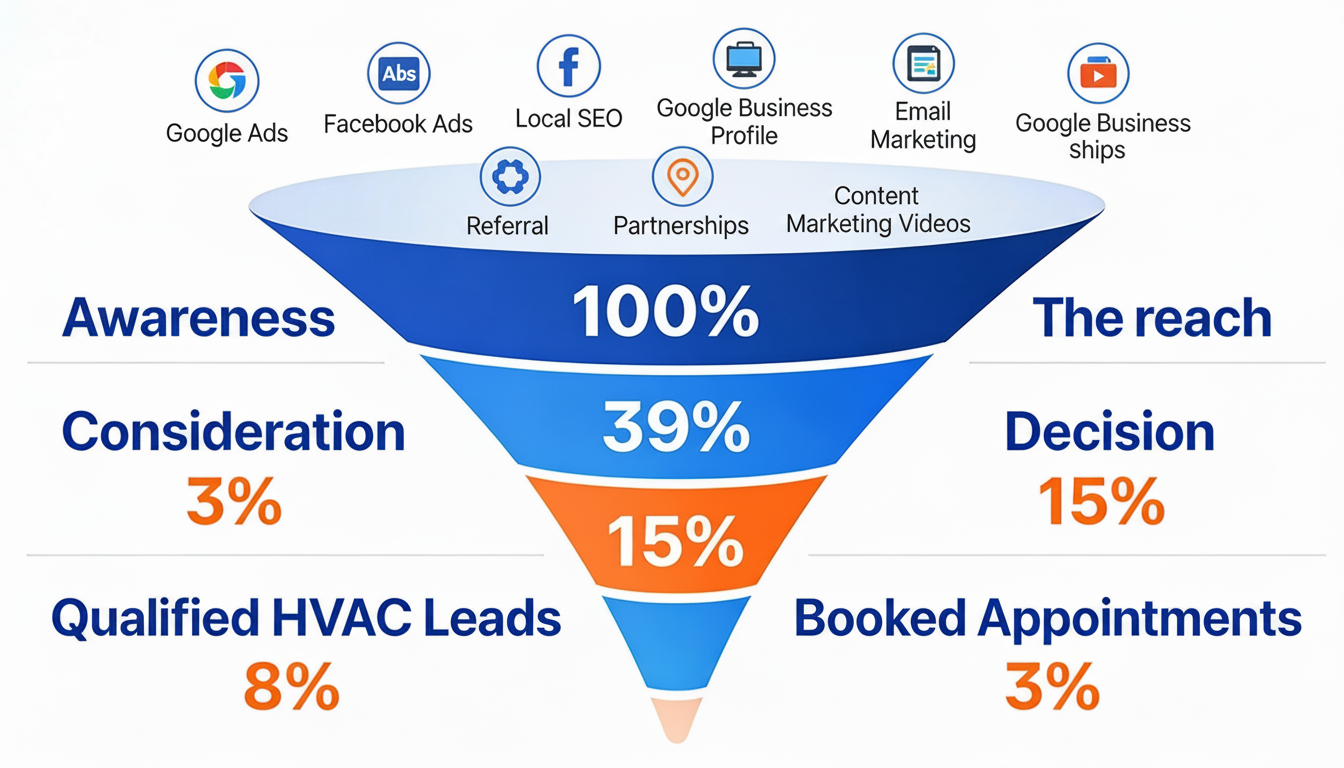
Quick Preview: The 7 Core Strategies to Get More HVAC Leads
You don’t need 20 tactics. You need the right ones executed with precision. Here’s what moves the needle:
- Local SEO and Google Business Profile domination gets you found by homeowners actively searching for your services.
- Google Ads and Facebook Ads capture intent when it’s hottest.
- A review generation system (automated) builds the social proof that closes deals.
- Email marketing and lead nurturing keeps you top-of-mind and turns maybes into bookings.
- Strategic partnerships and referrals bring steady, low-cost leads from trusted sources.
- Seasonal marketing campaigns align your message with what Sarasota homeowners need right now.
- Content marketing and video position you as the expert and save leads during shoulder seasons.
These aren’t new tricks. They’re fundamentals executed at a high level. Let’s dig into each one.
7 Best Ways to Get More HVAC Leads in Sarasota
Strategy 1: Master Your Google Business Profile (GBP) to Own Local Search
Your Google Business Profile is your storefront in the digital world.
When a homeowner in Sarasota searches “HVAC repair near me” or “air conditioning installation Sarasota,” they’re not looking at your website first. They’re looking at Google Maps. They’re looking at your profile. If your profile is incomplete, poorly maintained, or doesn’t stand out, you lose that lead before they ever contact you.
Here’s what most HVAC contractors get wrong: they treat their GBP like a set-it-and-forget-it directory listing. They fill in the basics, maybe add a photo or two, and call it done.
That’s leaving money on the table.
Claim, Verify, and Complete Your Profile
Start here if you haven’t already. Claim your business on Google Business Profile and verify ownership. This step alone tells Google you’re legitimate and active. A verified profile shows up in local search results and Google Maps—the places where Sarasota homeowners are looking.
Fill out every field. Don’t skip sections.
Your business name, address, phone number, website, business hours, and service areas all matter. Include every neighborhood and ZIP code you serve in Sarasota County. If you service Sarasota proper, Siesta Key, North Port, and Bradenton, list all of them. The more specific you are, the more local searches you’ll appear in.
Create a Service-Specific Profile Strategy
In your description, tell people exactly what you do. Instead of a generic “HVAC services,” use specifics: “AC repair, furnace installation, emergency heating service, duct cleaning, maintenance plans.”
List every service you offer as individual items within your profile. When someone searches for “furnace repair in Sarasota” or “AC installation near Siesta Key,” you want your service listing to match that query.
Use local keywords naturally in your description. Include the word “Sarasota” in your description. Mention specific areas you serve. This signals to Google that you’re a local business serving your community.
Populate Your Profile With Photos and Videos
Photos account for engagement on GBP.
Add high-quality images showing your team, your service vehicles, job sites, and completed installations. Include before-and-after shots of HVAC work. Show your technicians on the job. Show real customers giving thumbs up.
Video performs even better. A short video of your team introducing themselves or showing your process generates more engagement than static images. Google prioritizes profiles with recent, relevant media.
Update your photos seasonally. In summer, showcase AC work. In winter, highlight heating solutions. Fresh content keeps your profile active and signals to Google you’re current.
Answer Customer Questions Proactively
Use the Q&A section on your GBP to answer common questions before customers ask them.
“How much does an AC installation cost?” “Do you offer 24/7 emergency service?” “What’s included in a maintenance plan?” “Do you offer financing?”
When you answer these questions proactively, you’re doing two things: you’re removing barriers to contact, and you’re building trust before that first call.
Encourage and Manage Reviews Systematically
Reviews are the currency of local SEO. They directly impact rankings and click-through rates.
But here’s the real power: a homeowner who sees multiple 5-star reviews and sees how you respond to every review (even the negative ones) is far more likely to call you.
The strategy is simple: ask for reviews immediately after you complete a job, make it stupidly easy for customers to leave one, and respond to every single review.
Don’t wait. The moment a customer is satisfied, hand them a card with a QR code linking directly to your Google review page, or text them the link. Most people forget in 24 hours. Ask in the moment.
Use automation tools like NiceJob, Podium, or BirdEye to send review requests automatically via text or email after each job. The tool will remind customers if they don’t respond. This removes the burden from your techs and keeps reviews flowing without manual effort.
Respond to reviews—all of them. Thank customers for 5-star reviews. Address negative reviews professionally and quickly. The way you handle complaints matters more to future customers than the complaint itself.
Strategy 2: Dominate Local SEO With Strategic Keyword Targeting and Location Pages
Local SEO is the foundation of being found by Sarasota homeowners searching for your services.
Google wants to show local results to local searchers. Your job is to make it crystal clear to Google that you’re the right choice for that search.
Build a Keyword Strategy That Targets High-Intent Searches
Not all keywords are created equal.
Someone searching “HVAC maintenance tips” is learning. Someone searching “AC repair Sarasota” is ready to book. Target the second person.
Start with base keywords related to your services: AC repair, AC installation, furnace repair, furnace installation, emergency HVAC service, duct cleaning, maintenance plans.
Add location modifiers. “AC repair Sarasota.” “Furnace installation North Port.” “Emergency heating service Sarasota.” “Heat pump service Siesta Key.”
Go deeper with long-tail keywords. These are longer, more specific phrases with lower search volume but higher intent and less competition.
“Emergency AC repair in downtown Sarasota.” “Furnace installation for new homes in Sarasota.” “Affordable air conditioning repair near me.” “24-hour emergency heating service Sarasota.”
Use SEO tools like Semrush or Ahrefs to research actual search volume and competition. Find the sweet spot between search volume and competition difficulty.
Create Dedicated Service Pages and Location Pages
Your website should have a page for each service you offer and a page for each location you serve.
Not templated pages where you just swap out the city name. Unique content for each.
For a “AC Repair Sarasota” page, write content that specifically addresses what AC repair means, how your process works, what customers should expect, testimonials from Sarasota customers, and local considerations like humidity challenges in Florida homes.
For a “Furnace Repair Siesta Key” page, include details about the Siesta Key area, testimonials from Siesta Key customers, how your team serves that neighborhood, and why that matters.
Include the local manager’s name and photo on location pages. Feature customer testimonials from that specific area. Mention local landmarks and neighborhoods served. This builds relevance signals that tell Google, “This page is specifically about this location.”
Build Local Link Authority
Links from local websites signal to Google that you’re an authority in your local market.
Get links from local business directories, local news sites, community organizations, and local partner businesses.
Write guides that attract links. “How to Prepare Your Sarasota Home for Summer Heat.” “Winter Heating Tips for Sarasota Homeowners.” “The Impacts of Humidity on HVAC Systems in Florida.”
Local publications and community bloggers are far more likely to link to content that specifically addresses their community than generic HVAC advice.
Partner with local businesses like real estate agencies, plumbers, electricians, and home builders. Mention each other on your websites and in content. These local relationships build link authority and referral sources simultaneously.
Ensure NAP Consistency Across the Web
Your business name, address, and phone number need to be identical everywhere they appear online.
Check Google Maps, Yelp, Angi, the local chamber of commerce, and any business directories where you’re listed. Make sure the information matches exactly. Inconsistencies confuse Google’s algorithms and hurt your rankings.
Claim your business on every relevant platform. Update information immediately if you move, change your phone number, or adjust service areas.
Strategy 3: Launch Paid Advertising Campaigns That Capture Immediate Intent
SEO takes time. But you need leads now.
Google Ads and Facebook Ads give you immediate visibility to people actively searching for your services (Google) or people in your area who match your customer profile (Facebook).
Google Ads: Capture High-Intent Searches in Real-Time
When someone searches “AC repair Sarasota,” they have a problem and they’re looking for a solution today.
Google Ads puts you at the top of that search result. These are the hottest leads you can get.
Set up campaigns targeting local keywords with high intent. “Emergency AC repair Sarasota.” “Air conditioning repair near me.” “Furnace repair Sarasota.” “HVAC maintenance Sarasota.”
Use geographic targeting to focus your budget only on Sarasota and surrounding areas. You don’t need to show ads to people in Tampa or Miami.
Include call extensions in your ads. Make your phone number clickable and prominent. Many people will call directly from the ad.
Use search extensions to show your service areas, hours, and business information right in the ad.
Create dedicated landing pages for your ads. Don’t send people to your homepage. Send them to a page that speaks directly to their search. Someone clicking “AC repair” should land on a page about AC repair, not a generic HVAC page.
Monitor performance obsessively. Track which keywords generate leads at the best cost. Double down on winners. Kill campaigns losing money.
Expect a cost per lead between $50 and $100 for HVAC services, depending on competitiveness of your market and quality of your landing page.
Facebook Ads: Build Awareness and Retarget Non-Emergency Work
Facebook Ads work differently. People aren’t actively searching for your services on Facebook. You’re putting your message in front of them based on their interests and behaviors.
Facebook excels for non-emergency services like maintenance plans, seasonal tune-ups, system upgrades, and energy efficiency offers.
Use Facebook’s targeting to reach homeowners in Sarasota, within specific age ranges, with income levels that indicate they own homes, and with interests in home improvement.
Run seasonal campaigns. In summer, promote AC service specials. In fall, promote heating maintenance and emergency service plans. In winter, promote emergency heating service.
Use video content. A 15-30 second video showing your team, explaining a service, or walking through a completed job performs better than static images. Keep it authentic and real, not overly produced.
Retargeting campaigns capture people who visited your website but didn’t call. They’ve seen your services. Now you remind them to take action. These campaigns are cheap and highly effective.
Create lead-form ads that allow people to request a quote without leaving Facebook. Lower friction leads to more submissions.
Test multiple variations of ads. Different messages, different images, different offers. See what sticks.
Measuring Your Ad Spend ROI
Track the cost per lead from each campaign. Know which channel brings in the cheapest, highest-quality leads.
But more importantly, track which leads convert to jobs. A cheap lead that never converts is useless. An expensive lead that always books is gold.
Set up conversion tracking on your website so you can connect a clicked ad to a booked appointment. This gives you the real picture of what’s working.
Aim for a positive ROI within the first 30 days. If your ads cost more than they bring in revenue, something’s broken. Fix it or pause the campaign.
Strategy 4: Build a Lead Nurturing Engine With Email Marketing
Not every lead is ready to book immediately.
Someone googling “HVAC maintenance tips” is in research mode. Someone looking at your website is interested but not desperate. Someone comparing three contractors is deciding.
Email marketing keeps you in front of these people through the decision-making process.
Segment Your List and Send Targeted Messages
Don’t send the same email to everyone.
Segment your list by customer type (residential vs. commercial), service history (new customers vs. repeat customers), location (Sarasota proper vs. North Port), and behavior (opened your last email vs. never opens).
Send residential customers different messages than commercial customers. Send new customers an onboarding sequence explaining your services. Send past customers seasonal maintenance reminders.
Someone who’s never purchased is in a different place than someone who’s been your customer for three years. Message accordingly.
Automate the Boring Stuff, Personalize the Important Stuff
Set up automated email sequences.
A welcome sequence for new subscribers explaining what you do, your qualifications, testimonials, and a call to action.
An annual maintenance reminder sequence in fall reminding customers to schedule heating system tune-ups before winter.
An annual maintenance reminder sequence in spring reminding customers to schedule AC tune-ups before summer.
A follow-up sequence for people who’ve requested a quote but haven’t booked yet.
Automation handles the repetitive stuff. But personalization makes it work.
Address people by their first name. Reference their service history if they’re past customers. Customize the message to their situation if you have that data.
Use Email to Stay Top-of-Mind During Shoulder Seasons
HVAC work drops by 65 to 75% during shoulder seasons (spring and fall when weather is mild).
This is when email becomes your lifeline.
Instead of promotional messages, send educational content. “5 Signs Your Furnace Needs Repair.” “How to Improve Your Home’s Air Quality.” “Energy-Saving Tips for Sarasota Homes.”
Keep a 5-to-1 ratio: five educational emails for every one promotional email.
By the time emergency season hits, you’ve built so much goodwill that customers choose you over competitors.
Request Referrals in Email
Happy customers are a goldmine for referrals.
After a completed job, send an email thanking them for their business and asking them to refer friends or family if they know anyone who needs HVAC service.
Make it easy. Provide a referral link they can share or a simple way to forward your information.
Offer a small incentive. $25 off for them and a $25 credit for the referred customer. Or a free maintenance call on their next service. Make it worth their effort.
Strategy 5: Create Systematic Referral and Partnership Channels
The best leads are the ones you don’t have to pay for.
Referrals cost significantly less to acquire than paid leads, and referred customers close at higher rates because they come pre-sold.
Build referral programs and partnerships to create steady, low-cost lead flow.
Partner With Other Trades
HVAC work often happens alongside electrical work, plumbing work, and construction.
Reach out to electricians, plumbers, and general contractors in your area. Propose a simple referral partnership: you send them business, they send you business.
This doesn’t have to be a complex formal arrangement. Just a conversation: “Hey, when your customers need HVAC work, send them our way. When our customers need electrical work, we’ll send them to you.”
Homebuilders are gold for referral partners. They’re constantly building new homes that need HVAC systems. Getting on their approved contractor list means steady installation work.
Real estate agents frequently need HVAC services for inspections, repairs, or upgrades on properties they’re selling or managing. Build relationships with local agents. Make it known you’re the contractor they can trust.
Set Up a Customer Referral Program
Your existing customers are your best salespeople.
Create a simple referral program. When a customer refers someone who becomes a paying customer, offer them a reward. $25 off their next service. A free maintenance call. A discount on their next repair.
Tell customers about the program. After each job, hand them a card with referral details and a link to share.
Encourage your techs to talk about the referral program while they’re at the job. “By the way, if you know anyone who needs HVAC service, send them our way and we’ll take care of you both.”
You’ll be surprised how many referrals come from this simple ask.
Partner With Local Hardware Stores
Local hardware stores are trusted community resources.
Partner with them to cross-promote. You can offer their customers a discount on HVAC service. They recommend you to customers asking about HVAC needs. Set up a referral commission: you give them a percentage of any job they refer.
This works especially well for seasonal services. In fall, promote heating maintenance to hardware store customers buying supplies for fall prep. In spring, promote AC service.
Strategy 6: Leverage Seasonal Marketing to Capitalize on Predictable Demand Swings
Sarasota’s weather is predictable. Summers are brutal for AC. Winters are mild but heating still matters. This predictability lets you time your marketing perfectly.
Align Your Campaigns With Seasonal Demand
Summer (June-August): Emergency AC Service and Energy Efficiency
When it’s 95 degrees and humid, people need AC. Promote emergency AC repair with messaging emphasizing speed and reliability. “AC down? We’re here 24/7.”
Also promote AC maintenance and energy efficiency. “Save money this summer with an AC tune-up.” People are thinking about cooling costs.
Budget heavily for ads during this period. Demand is high, search volume is high, and people are ready to book.
Fall (September-November): Heating Prep and Maintenance
As temperatures start dropping, people begin preparing for winter. Promote heating system maintenance. “Don’t wait for a breakdown. Get your furnace ready for winter.”
Promote emergency heating service plans. “Sleep easy knowing we’re here 24/7 when you need us.”
Offer early-bird discounts for customers who schedule heating tune-ups before peak season hits.
Winter (December-February): Heating Reliability and Emergency Service
Heating emergencies spike in winter. Promote emergency service heavily. “Heating emergency? Call us anytime.”
Focus on heating repairs and reliability. Feature testimonials from customers praising your fast emergency response.
Spring (March-May): Maintenance and Upgrades
As weather becomes milder, promote maintenance and system upgrades. Spring is when people think about refreshing their homes.
Promote duct cleaning, air quality improvements, and system upgrades. “Ready for a fresh start? Improve your home’s air quality this spring.”
Create Seasonal Offers and Promotions
Match your offers to seasonal needs.
Summer: “$49 AC Tune-Up.” “Air Conditioning Installation + Free Duct Cleaning.” “Upgrade to a More Efficient AC Unit and Save on Energy Costs.”
Fall: “Free Furnace Inspection With Your Fall Tune-Up.” “Heating System Maintenance Special.” “Emergency Service Plan (Heating Coverage All Winter).”
Winter: “24/7 Emergency Heating Service.” “Furnace Repair (Priority Dispatch).” “Emergency Service Plan (Reduce Wait Times).”
Spring: “AC Maintenance Before Summer Heat.” “Home Air Quality Assessment.” “HVAC System Upgrade Special.”
Create urgency with limited-time offers. “Early-bird special ends October 31st.” “Limited spots available for emergency service plan enrollment.”
Allocate Budget Strategically
During peak seasons, spend more on advertising. Demand is higher, so ROI is better.
During shoulder seasons, spend less on promotional advertising, more on educational content that keeps you top-of-mind.
Build cash reserves during peak seasons to fund marketing during slower seasons.
Strategy 7: Use Content Marketing and Video to Own the Authority Position
When a homeowner has an HVAC question, you want them finding your content, not your competitor’s.
Content marketing (blog posts, videos, guides) positions you as the expert and generates organic traffic that requires no paid spend once published.
Create Blog Content That Answers Real Questions
Write blog posts answering questions your customers ask.
“How often should I change my HVAC filter?” “What’s the difference between an AC unit and a heat pump?” “Why is my AC not cooling?” “How to improve your home’s air quality.” “Energy-saving tips for HVAC systems.”
Write 800-1500 word posts that actually answer these questions in detail. Use your expertise. Share real examples and stories from your work.
Include local context. “How Sarasota’s humidity affects your HVAC system.” “Best HVAC systems for Florida homes.” “Winter heating needs in Southwest Florida.”
Optimize for search. Use the target keywords in your headline, subheadings, and throughout the post. Link to relevant service pages. Write for humans first, Google second.
Publish consistently. Shoot for one post per month minimum.
Create Video Content for YouTube, TikTok, and Instagram
Video is the most engaging content format.
Create short videos (30-60 seconds) showing quick tips. “How to replace your HVAC filter.” “5 signs your AC needs servicing.” “What to do if your furnace stops working.”
Create longer videos (3-5 minutes) doing deeper dives. A walkthrough of a full AC installation. A homeowner testimonial from a satisfied customer. A Q&A answering common HVAC questions.
Post these on YouTube, TikTok, Instagram Reels, and Facebook. Different platforms, same content. The algorithm spreads good content.
Keep videos authentic. No overly produced corporate nonsense. Real technicians, real explanations, real results. This builds trust.
Repurpose Content Across Channels
Blog posts become social media snippets. Videos become blog embeds. Testimonials become social media posts. One piece of content, multiple uses, maximum reach.
A good blog post about HVAC maintenance becomes:
- A social media post
- A series of TikToks or Reels with key points
- An email newsletter topic
- Talking points for sales calls
- A video walkthrough of key points
Partner With Zirbis SEO Agency or Local SEO Experts
If content and SEO aren’t your strength, partner with experts.
Companies like Zirbis SEO Agency specialize in local SEO for service businesses. They handle keyword research, content creation, on-page optimization, and link building.
The investment pays for itself when those top 10 rankings for “AC repair Sarasota” bring in consistent high-intent leads.
Don’t do this halfheartedly. Commit to SEO for at least 3-6 months before expecting major results. Rankings take time to build.
Related article: Top Sarasota SEO Companies
Quick Takeaways: The 7 Proven Strategies to Get More HVAC Leads
Here’s what actually moves the needle for HVAC businesses in Sarasota:
Optimize your Google Business Profile completely, keep it updated with fresh photos and reviews, and respond to every review. This gets you found in local search where most decisions happen.
Build dedicated location and service pages targeting high-intent keywords with unique, locally-relevant content that speaks directly to Sarasota homeowners.
Run consistent Google Ads campaigns targeting emergency and maintenance searches, and Facebook Ads campaigns during specific seasons to build awareness for non-emergency services.
Set up email automation sequences for follow-ups, seasonal maintenance reminders, and referral requests that keep you top-of-mind and cost almost nothing to send.
Create referral partnerships with complementary trades, real estate agents, homebuilders, and hardware stores to build steady, low-cost lead channels.
Align all advertising, messaging, and offers to Sarasota’s predictable seasonal patterns: heavy AC promotion in summer, heating prep in fall, emergency service emphasis in winter, and maintenance focus in spring.
Create blog posts and videos answering real questions your customers ask, optimized for search, that build authority and generate organic traffic over time.
Implement these seven strategies simultaneously, measure your results, and double down on what works. You won’t get instant results. But within 90 days, you’ll notice more leads. Within six months, you’ll have a system that generates consistent, qualified leads without you thinking about it.
Conclusion
The difference between HVAC contractors drowning in leads and those struggling to fill their schedule isn’t luck or market conditions. It’s strategy, execution, and consistency.
You have the ability to dominate your local market in Sarasota. Your competitors probably aren’t doing what we’ve outlined here. Most HVAC contractors treat marketing like an afterthought. They get a few Google ads running, maybe a Facebook page, and wonder why they’re not booked solid.
The contractors winning are those taking a systematic, multi-channel approach. They own their Google Business Profile. They’ve built authority through content and reviews. They’ve created referral partnerships. They’ve set up email automation. They’re running ads during peak seasons. They understand their market seasonality and plan accordingly.
You can do exactly this.
Start with one or two strategies this month. Don’t try to implement everything at once. Get your Google Business Profile dialed in first. That’s the foundation. While that’s building authority, set up a simple email automation sequence. Next month, launch a Google Ads campaign or create a blog post. Build momentum.
The goal isn’t perfection. It’s consistency and improvement. Each month, your lead generation system gets better. Each quarter, you’re running smarter campaigns with better data. Each year, you’re capturing a larger share of the Sarasota HVAC market.
Your reputation and the quality of your work are givens. Now it’s time to make sure Sarasota homeowners know you exist and that you’re the best choice for their HVAC needs.
The market is there. Your competitors are there. The question is: are you going to claim your share?
FAQ
Q: How long does it take to see results from SEO and content marketing?
A: SEO is a long game. You’ll typically see noticeable improvements in search rankings and organic traffic within 3-6 months if you’re implementing best practices consistently. Some ranking improvements happen in 4-8 weeks, but major traffic gains take longer. Paid ads (Google, Facebook) show results immediately.
Q: What’s a realistic cost per lead for HVAC services in Sarasota?
A: Google Ads typically runs $50-100 per lead depending on keyword competitiveness and landing page quality. Facebook Ads usually run cheaper, $30-60 per lead. The best leads (referrals) cost almost nothing. Your ROI depends on your closing rate and job margins.
Q: How many reviews do I need to rank well in local search?
A: More is always better, but quality beats quantity. You can rank well with 20-30 high-quality reviews if they’re recent and you respond to all of them. The highest-ranking contractors typically have 50+ reviews, but the real power is in consistent new reviews and a high average rating (4.5+ stars).
Q: Should I hire an SEO agency like Zirbis for my HVAC business?
A: If you have time and passion for SEO, you can do it yourself. If you don’t, hiring an agency that specializes in local SEO for service businesses is worth the investment. They bring expertise, handle the technical work, and typically generate ROI within 6-12 months.
Q: What’s the best time to start my seasonal marketing campaigns?
A: Start one month before peak season. Summer AC campaigns in May. Fall heating campaigns in August. Winter emergency campaigns in November. Spring maintenance campaigns in February. Early birds catch more worms.