You’ve got the skills. Your team shows up on time, fixes problems right, and customers appreciate the work. But between you and me, the phone ringing inconsistently keeps you up at night.
Most plumbing contractors in Sarasota are running in reactive mode. They’ll have a crazy busy week, then ghost quiet. The ups and downs mess with cash flow, scheduling, and your ability to plan.
The problem isn’t your plumbing skills. It’s that you’re probably doing lead generation the same way you did five years ago (or maybe not doing it at all).
Here’s the real situation: the market in Sarasota for plumbing work is wide open. Homeowners need plumbing services year-round. Winter brings frozen pipes and bursting lines. Summer brings water pressure issues and hot water problems. Spring brings maintenance calls from winter damage. Fall brings prep work before winter hits hard.
The demand exists. The money is there. You’re just not positioned in front of the people searching for plumbing services.
This article walks you through the exact lead generation strategies that work for plumbing contractors in 2025. Not theoretical stuff. Real tactics that fill pipelines, convert calls into jobs, and build systems that work whether you’re in the office or not.
What separates contractors pulling in consistent leads from those struggling is strategy execution. You’ll learn what channels actually work, which ones drain money, how to position yourself in front of people actively looking for your services, and how to nurture relationships that turn into repeat business and referrals.
Let’s build your lead generation machine.
Table of Contents
Quick Preview: The 9 Core Strategies That Move the Needle
You don’t need to be everywhere. You need to be in the right places doing the right things.
Google Local Services Ads captures high-intent emergency calls at the exact moment homeowners need help.
Local SEO and Google Business Profile optimization gets you found by Sarasota homeowners searching for plumbing on their phones.
Strategic partnerships with real estate agents, HVAC contractors, and other trades feed you steady, low-cost referrals.
Email marketing automation keeps past customers coming back with maintenance reminders instead of watching them call your competitor.
Video content and social media position you as the local expert and build trust before that first call.
Seasonal marketing campaigns align your message with what Sarasota homeowners need right now.
Website optimization and lead tracking ensure every dollar you spend generates measurable returns.
Each one of these works. Combined, they create an unstoppable lead flow. Let’s dive in.
The 9 Core Strategies That Bring Plumbing Leads in Sarasota
Strategy 1: Dominate Google Local Services Ads (LSA) for Immediate, High-Intent Leads
Google Local Services Ads is the closest thing to plumbing gold in digital marketing.
Here’s why: when someone searches “emergency plumber near me” at 2 AM on a Sunday because their pipe burst, they’re ready to hire immediately. They’re not comparison shopping or getting three quotes. They need someone now.
Google Local Services Ads puts you directly in front of that person. And you only pay when they actually contact you—not for clicks, not for impressions, just for real leads.
Why LSA Beats Regular Google Ads for Plumbers
Google Ads charges per click. Someone might click your ad out of curiosity and never call. You paid for that click anyway.
Google Local Services Ads is different. You pay per lead. Someone contacts you through Google’s platform, you pay. No contact, no charge. This filters out the tire kickers and window shoppers.
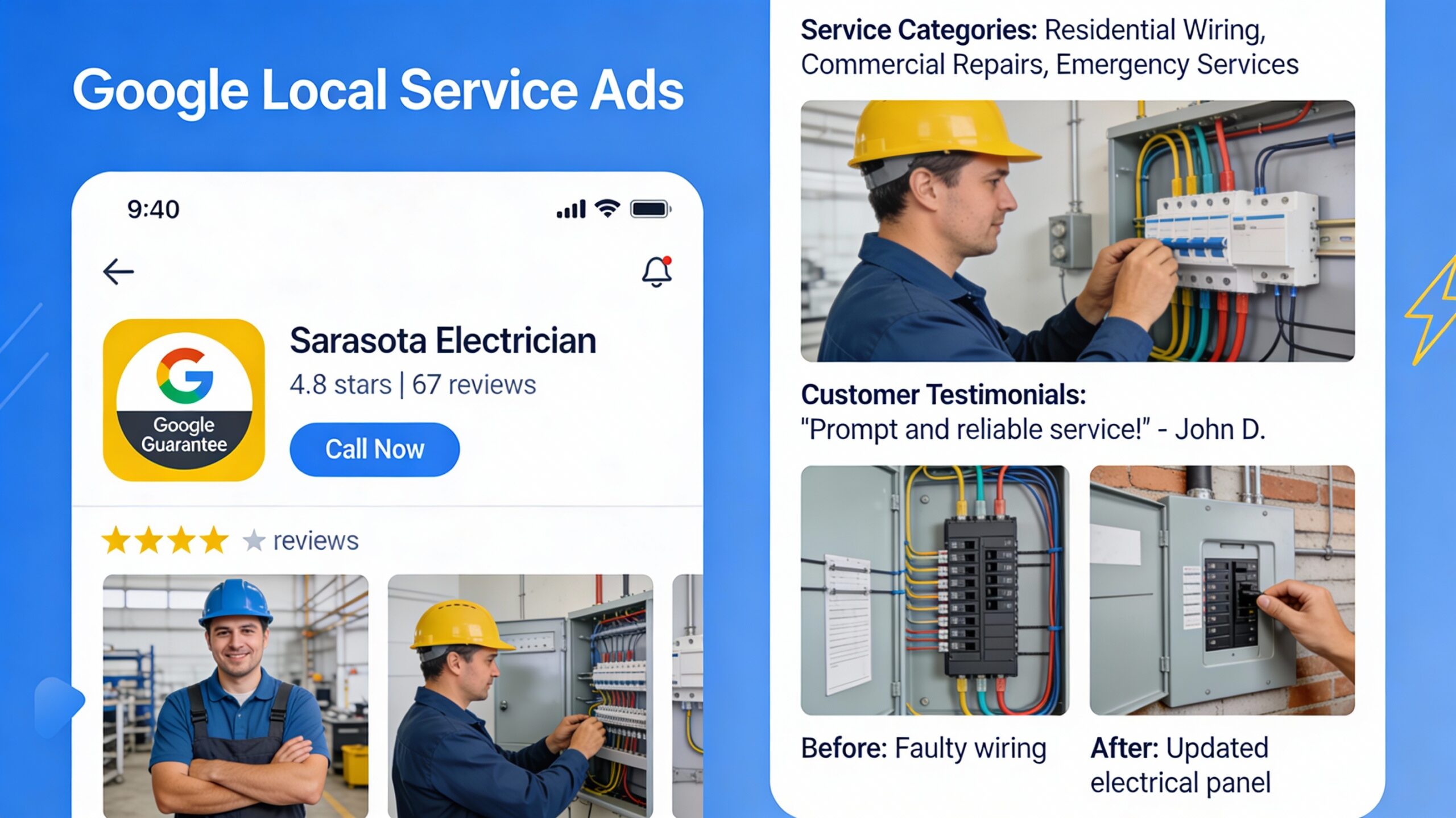
The Google Guarantee badge also appears on your LSA listing. This tells homeowners that Google has verified you’re legitimate, you’re insured, and if something goes wrong, Google stands behind it. That badge alone increases trust and conversion rates.
Set Up Your LSA Campaign in 4 Steps
First, make sure you have a verified Google Business Profile. This is non-negotiable. Google requires it as of November 2024. If you don’t have one yet, claim it, verify ownership, and complete every field.
Second, log into your Google Ads account and select “Local Service Ads” as your campaign type. Choose your service area. Be specific. If you serve Sarasota proper and surrounding areas like North Port and Siesta Key, list them all. Precision matters.
Third, select the plumbing services you offer. Emergency repair? List it. Water heater replacement? List it. Drain cleaning? List it. The more services you activate, the more opportunities Google has to match you with customers searching for those services.
Fourth, set your budget and launch. Start conservatively. Maybe $50 a day. Monitor which types of leads come through, which ones convert to jobs, which ones are tire kickers. You’ll learn fast.
Strategy: Lead Type Targeting
Not all LSA leads are created equal.
Emergency repair calls convert faster and close at higher rates than non-emergency services. Someone with a burst pipe needs help today and will book on the spot. Someone thinking about upgrading to a tankless water heater might sit on it for weeks.
Start by activating and prioritizing emergency services on your LSA campaign. These are your fast cash flow, low-friction leads. Build budget here first.
Once you’re crushing emergency calls, layer in water heater replacements. High-ticket items, good margins, proven conversion channel.
Then add drain cleaning, maintenance, and other services as you optimize the emergency and water heater channels.
Manage Your Reviews Obsessively
Your LSA ranking and lead volume directly correlate to your review quality and quantity.
Google prioritizes plumbers with strong review profiles. More reviews, higher average rating, and recent activity all signal to Google that you’re trustworthy and busy.
After every job, ask for a review. Not a follow-up email asking nicely. Hand them your phone, show them where to click, and watch them leave the review while you’re standing there. Or text them a link immediately after you complete the job.
The moment you get a negative review (and you will), respond professionally. Don’t get defensive. Apologize for the experience and offer to make it right. Potential customers read how you handle complaints. The way you respond matters more than the complaint itself.
Track LSA Performance Ruthlessly
Know your cost per lead from LSA. Know your conversion rate. Know your average job value from LSA leads.
If your cost per LSA lead is $40 and your conversion rate is 40%, you’re paying $100 per job. If your average plumbing job is $500, that’s a 5x return. Keep pushing budget here.
If cost per lead is climbing and conversions are dropping, something’s broken. Maybe your pricing is too high. Maybe your response time is slow. Maybe your reviews are declining. Diagnose and fix it.
Strategy 2: Master Local SEO to Get Found in Organic Search
Google Local Services Ads captures immediate intent. But what about homeowners who are searching, comparing, and gathering information before they call?
Local SEO ensures you show up in their search results when they look for “plumber near me” or “emergency plumber Sarasota” on Google.
This traffic is free once you’ve optimized. No cost per click. No cost per lead. Just showing up because Google knows you’re the right answer for that search in that location.
Claim and Optimize Your Google Business Profile Completely
Your Google Business Profile is your local storefront.
Claim it. Verify ownership. Then fill out every single field Google gives you. Business name, address, phone, website, hours of operation, service areas, business categories, services offered.
Write a detailed business description that naturally includes your location and services. “Emergency plumbing repair, water heater replacement, and drain cleaning for Sarasota and North Port homeowners. Available 24/7.”
Upload high-quality photos. Show your team. Show your service vehicles. Show completed work before and after. Fresh, real photos beat stock images every time.
Add your services as individual items within your profile. Water heater installation, emergency repair, drain cleaning, leak detection. Each service listing is another chance for Google to match you with a customer searching for that specific service in your area.
Answer customer questions in the Q&A section. “Do you offer 24/7 emergency service?” “What areas do you serve?” “Do you offer financing?” Answer these proactively so customers see the information before they call.
Build Location and Service Pages on Your Website
Your website needs a page for each neighborhood or service area you cover and a page for each service you offer.
Not templated pages where you swap out city names. Unique, specific content for each location.
For a “Plumbing Services in Sarasota” page, write content specific to Sarasota. Mention neighborhoods by name. Talk about local plumbing challenges (humidity, older homes, salt water exposure). Include testimonials from Sarasota customers. Feature your Sarasota team member’s photo and experience.
For a “Water Heater Replacement in North Port” page, do the same for North Port. Make each page feel locally specific.
This signals to Google, “This page is specifically about this location and service combination.” Google rewards that specificity with higher rankings.
Target High-Intent Local Keywords
Not all keywords are created equal.
Someone searching “plumbing tips” is learning. Someone searching “emergency plumber Sarasota” is ready to hire.
Target the second group.
Start with base keywords: emergency plumber, water heater repair, drain cleaning, burst pipe repair, leak detection.
Add location: “Emergency plumber Sarasota,” “Water heater repair North Port,” “Burst pipe repair Siesta Key.”
Go deeper with long-tail keywords (longer, more specific phrases with lower search volume but higher intent): “Affordable emergency plumber near me,” “Burst pipe repair cost Sarasota,” “24-hour plumber in downtown Sarasota.”
Use Google Keyword Planner to research actual search volume for these phrases. Find the sweet spot between enough search volume to matter and low enough competition to rank.
Build Local Links and Citations
Links from local websites signal to Google that you’re an authority in your local market.
Get listed in local business directories: Yelp, Angie’s List, Thumbtack, Google My Business. Make sure your business name, address, and phone number are identical across all platforms (NAP consistency).
Write helpful guides that attract local links. “How to Prevent Frozen Pipes in Sarasota” or “Why Coastal Humidity Damages Plumbing Systems.” Local news sites and community bloggers are far more likely to link to content that addresses their specific community.
Partner with complementary local businesses. Get linked from HVAC company websites, real estate agent sites, and general contractor sites. These local relationships build link authority and referral sources simultaneously.
Strategy 3: Use Google Ads and PPC to Capture Immediate, High-Intent Searches
SEO takes months to build. But you need leads now.
Google Ads puts your ad at the top of search results the moment someone searches for your services. These are some of the hottest leads you can get.
The key is being strategic about where you spend money and making sure every dollar converts.
Build Your Google Ads Campaign With Precision
Start with emergency and high-intent keywords. “Emergency plumber Sarasota,” “Burst pipe repair near me,” “Frozen pipe emergency,” “Water heater emergency.”
People searching these phrases have a problem and they’re looking for a solution immediately.
Use geographic targeting to focus your budget only on Sarasota and surrounding areas. You’re not paying to show ads to people in Tampa.
Create separate ad groups for different service types. Emergency repairs, water heater service, drain cleaning, maintenance. Each gets its own message because each solves a different problem.
For emergency services, emphasize speed and availability. “Emergency plumber. Available 24/7. Same-day appointments.”
For water heater replacement, emphasize pricing and quality. “Free estimates. Expert installation. 5-year warranty.”
For drain cleaning, emphasize results. “Hydro jetting. Fast. Permanent results.”
Create Service-Specific Landing Pages
Don’t send someone clicking “emergency plumber” to your homepage.
Send them to a page specifically about emergency plumbing service. It should say “Emergency Plumber” in the headline. It should show your response time (“Usually within 2 hours”). It should have clear CTAs (“Call now” or “Book emergency service”).
When landing page content matches the ad copy, Google rewards you with better ad quality scores, lower costs per click, and higher conversion rates.
Test different messaging and see what works. “Same-day appointment,” “24/7 available,” “No service charge,” “Fast response time.” Find what resonates with Sarasota homeowners.
Track Cost Per Lead and Conversion Rate Obsessively
The plumbing industry benchmark is around $53 cost per lead, but it varies wildly based on competitiveness and quality.
Track your cost per lead from Google Ads. Track how many of those leads convert to jobs.
If you’re spending $60 per lead and converting 25% to jobs at $600 average value, you’re at $240 cost per job. That’s solid ROI. Double down on that channel.
If you’re spending $80 per lead and converting 10% to jobs, you’re at $800 cost per job on average. That’s not working. Either improve your conversion rate or pause that campaign.
Test different keywords, different messaging, different landing pages. Small improvements in conversion rate make massive impacts on profitability.
Strategy 4: Leverage Email Marketing to Build a Retention Engine
Getting a new customer costs five to 25 times more than keeping an existing one.
But most plumbing contractors treat email like an afterthought. They get a customer’s email address and never use it again.
That’s money on the table.
Email marketing automation ensures past customers keep calling you instead of shopping around when they need plumbing work again.
Set Up Seasonal Maintenance Reminder Sequences
Create automated email sequences that remind customers about maintenance at the right time.
In October or November, send an email to all customers: “Winter is coming. Frozen pipes cause $3000+ in damage on average. Schedule your winter plumbing inspection now.”
In April or May, send another: “Summer water pressure spikes can burst old pipes. Get a water pressure test. Protect your home.”
These emails save customers money, position you as an expert, and get them to call you before problems happen. That’s the sweet spot.
Automate Maintenance Follow-Ups
When you install a water heater, set up an automated email for 11 months later. “It’s been a year since your water heater installation. Many issues show up around the 12-month mark. Schedule a quick inspection. It’s free.”
When someone requests an estimate but doesn’t book, set up a follow-up sequence. Day 3: “Hey, just checking in on that estimate we sent over. Any questions?” Day 10: “Still thinking about that plumbing project? Let’s get it scheduled.”
When a customer hasn’t called in over a year, send a gentle reminder. “We haven’t heard from you in a while. If you need anything, we’re here.”
These feel like personal touches but they’re all automated. You set the rules once and the system runs forever.
Get Segmentation Right
Don’t send the same email to everyone.
Segment your list by customer type (residential vs. commercial), service history (emergency repair vs. water heater install), and location.
Residential customers get different messages than commercial. A water heater install customer gets a different follow-up sequence than a drain cleaning customer.
By season, send relevant content. Winter: frozen pipe prevention, water heater maintenance. Summer: water pressure management, leak detection tips.
Include Referral Requests in Email Campaigns
Happy customers are your best salespeople.
After a successful job, send an email thanking them for their business and asking them to refer friends or family if they know anyone needing plumbing work.
Make it easy. Provide a referral link they can share or a simple way to forward your information.
Offer a small incentive. “Refer a friend and you both get $25 off your next service.”
You’ll be shocked how many referrals come from this simple ask.
Strategy 5: Build Systematic Referral and Partnership Channels
The best leads are the ones you don’t have to pay for.
Referrals cost almost nothing to acquire and convert at 30-50% rates. Paid leads often convert at 10-15%.
Build partnerships that create steady, low-cost lead flow.
Partner With Real Estate Agents
Real estate agents interact with homeowners constantly. New homeowners often need plumbing work. Sellers sometimes need plumbing repairs to close deals. Agents frequently recommend contractors.
Reach out to local real estate agents. “When your clients need plumbing work, send them our way. We’ll take good care of them.”
Offer special pricing for agent referrals. Offer to provide free estimates to help with home inspections. Get on their recommended contractor lists.
Many agents include contractor recommendations in their homebuyer packets. That’s gold. Getting your name and number in those packets means steady referrals from new residents who don’t have a plumber yet.
Partner With HVAC Contractors, Electricians, and Other Trades
HVAC work often happens alongside plumbing. Same with electrical and general contracting.
Build relationships with local HVAC companies, electricians, and general contractors. “When your customers need plumbing, refer them to us. We’ll refer our customers to you when they need HVAC or electrical work.”
These aren’t formal arrangements. Just conversations and follow-through. When someone comes to you with an HVAC need, send them to your HVAC partner. When they send you a plumbing customer, take great care of them. The referrals will flow both directions.
Create a Formal Customer Referral Program
Your existing customers already know you do good work.
Create a simple referral program. When a customer refers someone who becomes a paying customer, offer them a reward. $25 off their next service, a free maintenance call, or a discount on their next job.
Tell customers about the program. After each job, hand them a card with referral details and a link to share.
Encourage your techs to mention the program while they’re at the job. “By the way, if you know anyone who needs plumbing work, send them our way and we’ll take care of you both.”
Partner With Hardware Stores and Home Improvement Shops
Local hardware stores are trusted community resources where homeowners go when they have problems.
Partner with them to cross-promote. You provide them with business cards and brochures. They recommend you to customers asking about plumbing. You offer a referral commission to incentivize recommendations.
This works especially well for seasonal services. In fall, promote winter prep and frozen pipe prevention. In spring, promote water heater and general maintenance.
Team Up With Home Cleaning Companies
Home cleaning companies visit homeowners regularly. They see the homes, talk to homeowners, and have trust.
Partner with them. Include your promotional materials in their service packages. Offer referral incentives. Cross-promote to each other’s audiences.
Home cleaning customers value convenience and quality. Many of them will also value having a reliable plumber on speed dial.
Strategy 6: Capitalize on Seasonal Demand Patterns in Sarasota
Sarasota’s weather is predictable. This gives you an advantage.
Winter brings frozen pipes and burst lines. Summer brings leaks and water pressure issues. Spring brings maintenance calls from winter damage. Fall brings winter prep work.
By aligning your marketing to these seasons, you optimize your spend and message timing.
Winter Strategy: Frozen Pipes and Emergency Service
In winter, searches for “frozen pipe repair” spike 609% according to industry data.
This is your goldmine season. Homeowners are panicked and willing to pay premium rates for fast service.
Launch your heaviest Google Ads campaigns in November and December. Promote your 24/7 emergency service with messaging like “Frozen pipes? We’re available 24/7. Same-day service.”
Create email campaigns about frozen pipe prevention. “5 ways to prevent frozen pipes.” “What to do if your pipes freeze.” Position yourself as the expert before the emergency happens.
Offer emergency service plan promotions. “Pay one small fee upfront and you get priority dispatch and discounted rates all winter.” This locks in recurring revenue during peak season.
Summer Strategy: Water Pressure and General Maintenance
Summer brings heat stress on plumbing systems. Water pressure issues spike. Hot water problems increase.
Launch campaigns promoting water pressure checks and general plumbing inspections. “High water pressure damages pipes. Get a free inspection.”
Promote summer maintenance. “Prepare your plumbing for summer heat. Schedule your seasonal checkup.”
Update your website and ads with summer imagery. Blue water, sun, hot days. This primes customers thinking about summer plumbing issues.
Spring Strategy: Repairs and Upgrades
Spring is home improvement season. Homeowners are refreshing their homes.
Promote water heater replacements. “Old water heater? Replace it this spring with a modern, efficient unit.”
Promote repiping and upgrade services. “If your home is over 40 years old, repiping prevents future emergencies.”
Partner with hardware stores for joint spring promotions. Co-market maintenance packages and upgrades.
Fall Strategy: Winter Preparation
Fall is when homeowners prepare for winter.
Promote heating system plumbing inspection and winter preparation. “Get your plumbing ready for winter. Hydro-jetting, pipe inspection, winterization.”
Promote drain cleaning. “Clean drains handle more volume. Get your drains hydro-jetted before winter.”
Offer early-bird discounts. “Schedule your winter inspection by October 31st and get 15% off.”
Create educational content about winter prep. Blog posts, videos, email campaigns all emphasizing what homeowners should do before winter.
Create Seasonal Offers and Promotions
Match your offers to seasonal needs and create urgency.
Winter: “$49 winter plumbing inspection.” “Frozen pipe emergency plan (covers call + discount on service).” “Burst pipe? $99 same-day diagnosis.”
Summer: “Water pressure check (free).” “Summer plumbing checkup special.” “Upgrade to efficient fixtures (save on water bill).”
Spring: “Water heater replacement special.” “Spring maintenance package.” “Free repiping assessment.”
Fall: “Winter prep inspection.” “Early-bird winter service plan discount.” “Drain cleaning special.”
Limit the offers to specific dates. “Early-bird special ends October 31st.” “Holiday emergency service plan enrollment ends December 15th.” Scarcity creates urgency.
Strategy 7: Create Video Content and Social Media Authority
When a homeowner has a plumbing question, you want them finding your content, not your competitor’s.
Video and social media position you as the expert and generate organic traffic that costs nothing once created.
Create How-To Videos for YouTube
YouTube is the second largest search engine. When someone searches “how to fix a leaky faucet” or “how to unclog a drain,” they often find YouTube videos first.
Create videos answering common plumbing questions. “How to identify a leaky pipe.” “Signs your water heater is failing.” “How to prevent frozen pipes.” “What to do if your pipes burst.”
Keep videos authentic. Real technicians, real explanations, real problems. No overly produced corporate nonsense. Authenticity builds trust.
Optimize your videos for search. Use the keywords you’re targeting in the title, description, and tags. Link to relevant service pages in the description.
Embed YouTube videos on your website service pages. This improves your page’s engagement metrics and keeps people on your site longer.
Post Short-Form Video Content on Social Media
Video content gets 95% retention compared to 10% for text. Video dominates.
Create short clips (30-60 seconds) for TikTok, Instagram Reels, and Facebook showing quick tips. “How to replace your ac filter (wrong way).” “5 signs your water heater needs replacement.” “What causes burst pipes.”
Behind-the-scenes videos showing your team working. “A day in the life of a Sarasota plumber.” Team introductions. Job site walkthroughs.
Customer testimonials. Real customers talking about their experience working with you. This builds social proof.
Post consistently. At least twice per week. Use relevant hashtags. Like and engage with other local business content.
Share Before and After Photos
Plumbing doesn’t have glamorous imagery, but before and afters tell a story.
Before: water pooling under sink. After: fixed leak, clean install. Before: rusty old pipes. After: new copper piping. Before: slow drain. After: hydro-jetted, flowing fast.
Add captions explaining the problem, your solution, and the result. “Water heater burst and damaged the surrounding area. We replaced the heater, repaired drywall damage, and tested the entire system. Customer saved thousands by catching it early.”
Share these on Facebook, Instagram, and email. They demonstrate your expertise and results.
Build a Blog With Evergreen Content
Write blog posts answering questions your customers ask.
“How often should I replace my water heater?” “What causes low water pressure?” “How to prepare for winter.” “Emergency plumbing: what to do before the plumber arrives.”
Write 800 to 1500 words per post. Actually answer the question with expertise. Include examples from your work. Include local context where relevant.
Publish consistently. One post per month minimum. This builds authority over time and gives Google multiple pages to rank for related keywords.
Link your blog posts to service pages. “Is your water heater acting up? Learn more about water heater replacement.”
Partner With Zirbis SEO Agency or Local Experts
If content and SEO aren’t your strength, partner with experts who specialize in local plumbing marketing.
Companies like Zirbis SEO Agency focus on getting service businesses ranked for local keywords and driving qualified leads.
The investment pays for itself when those top rankings for “emergency plumber Sarasota” bring in consistent work.
Don’t do this halfheartedly. Commit to an SEO partnership for at least 3-6 months before expecting major results. Rankings take time to build.
Strategy 8: Optimize Your Website for Maximum Conversions
Having traffic is useless if it doesn’t convert to leads.
Your website needs to be fast, mobile-friendly, and conversion-focused.
Mobile-First Design Is Non-Negotiable
Over 60% of traffic to your website comes from mobile devices.
Your site must load fast on mobile (under 3 seconds). Use Google PageSpeed Insights to identify speed issues. Compress images, optimize code, reduce server response time.
Make buttons and CTAs easy to tap on a phone screen. Make the phone number clickable so people can call with one tap. Make booking forms quick and simple.
A mobile optimization that reduces page load time from 6 seconds to 3 seconds can increase conversions by 183%.
Create Clear Calls to Action
Every page needs a clear, specific call to action.
“Call now,” “Book appointment,” “Get free estimate,” “Chat with us.” Make it obvious what you want the visitor to do next.
Put your phone number in multiple places. At the top of the page, in the header, in the footer. Make it impossible to miss.
Use forms for lead capture but keep them short. Name, phone, service needed. Three fields. Don’t ask for their life story.
Offer live chat. Some people prefer texting or chatting to calling. Give them options.
Use Testimonials and Social Proof
Potential customers want to know you’re reliable and good at what you do.
Feature customer testimonials prominently. Include names, photos, and what they had done. “John Smith, Sarasota: ‘Same-day emergency service saved us. Professional, fast, fair pricing. Highly recommend.’ “
Feature your credentials, licenses, insurance, and certifications. Show you’re the real deal.
Display review ratings. “4.8 stars from 47 reviews.” This validates your quality.
Show your Google Guarantee badge if you have LSA. This signals Google’s endorsement.
Create Service-Specific Landing Pages
Different services require different messaging.
Your emergency service landing page should emphasize speed. “Available 24/7. Usually here within 2 hours.”
Your water heater replacement page should emphasize options and savings. “Free estimate. Multiple brands. 10-year warranty available.”
Your maintenance page should emphasize prevention. “Prevent expensive emergencies. Regular maintenance saves money.”
Each page should have specific keywords, specific problems it solves, and specific CTAs.
Strategy 9: Build Systems for Lead Tracking and Measurement
You can’t improve what you don’t measure.
Track which channels bring in leads, which ones convert to jobs, which ones are most profitable.
Track Cost Per Lead and Conversion Rate by Channel
Know your Google Ads cost per lead. Know your LSA cost per lead. Know your organic search cost per lead (zero, but track the volume).
Track how many leads from each channel become jobs. If LSA converts at 40%, Google Ads at 25%, and organic at 30%, prioritize based on profitability.
Calculate your customer lifetime value. How much does an average customer spend with you over years? Include initial jobs, repeat calls, referrals they send. Use this to determine how much you can afford to spend acquiring customers.
Use Call Tracking and Dynamic Numbers
Assign unique phone numbers to different marketing channels. One number for Google Ads, one for Facebook, one for organic search.
When someone calls, you instantly know which channel they came from. This tells you where to spend more money and where to cut.
Use dynamic number insertion on your website. When someone lands from a Google Ad, they see one phone number. When they land from organic search, they see a different number. This tracks phone calls to source.
Set Up a CRM to Track Leads and Jobs
A CRM (customer relationship management system) tracks every interaction with every lead and customer.
When a lead comes in, log it. Note which channel. Note the service type. Note the estimated value. Note the follow-up date.
Track the progress from lead to quote to job. See where leads drop off. See which team members convert best. Identify bottlenecks.
Use your CRM data to make decisions. “Our emergency repair channel is converting at 50%, but our water heater channel is only converting at 10%. Let’s focus budget on emergency repair and improve the water heater sales process.”
Review Performance Monthly
Set a monthly review meeting. Pull up your numbers. Cost per lead by channel. Conversion rates. Revenue generated. ROI.
Identify what’s working. Double down on those channels.
Identify what’s not working. Either optimize it or pause it.
Celebrate wins. If you crushed it in November, acknowledge it. If you need to improve, acknowledge that too.
Adjust your strategy based on data. Not gut feeling. Data.
Quick Takeaways: The 9 Proven Strategies That Fill Your Pipeline
Google Local Services Ads is your fastest path to high-intent emergency calls that convert immediately. Set it up, manage your reviews obsessively, and track your numbers weekly.
Local SEO and Google Business Profile optimization get you found by homeowners searching for plumbing services in Sarasota. This traffic is free once optimized. It takes three to six months to build but the payoff is permanent.
Google Ads and PPC capture immediate search intent for specific services. Track cost per lead ruthlessly and kill campaigns that don’t work. Maintain your quality score by matching ad copy to landing page content.
Email marketing automation keeps past customers coming back instead of shopping around. Set up seasonal reminders, maintenance follow-ups, and referral requests. Low cost, high lifetime value.
Strategic partnerships with real estate agents, HVAC contractors, and other trades create steady, low-cost referral flow. Build relationships where you mutually refer business to each other.
Seasonal marketing campaigns align your messaging with Sarasota’s predictable weather patterns. Winter focuses on frozen pipes, summer on water pressure, spring on upgrades, fall on winter prep.
Video content, social media, and blogging position you as the local expert. This builds trust and generates organic traffic. Takes time but costs almost nothing once created.
Conclusion
The market for plumbing services in Sarasota is massive. Homeowners need your services year-round. They have problems you solve. They have money to spend.
The difference between contractors making $50,000 a year and contractors making $200,000 a year isn’t the quality of their work. It’s their lead generation system.
You could do one or two of these strategies and see results. But the contractors dominating their markets are using all of them in concert. They’ve got Google Ads running. They’ve got LSA active. They’ve got a strong Google Business Profile with tons of reviews. They’ve got email automation keeping past customers engaged. They’ve got referral partnerships feeding steady leads. They’ve got seasonal campaigns running. They’ve got video and content building authority.
This isn’t complicated. It’s just execution and consistency.
Start with one strategy this month. Get your Google Business Profile dialed in. While that’s building, set up a simple email automation sequence. Next month, launch a Google Ads campaign or start creating YouTube videos.
Each month, add another piece. Build momentum. Track your numbers. Optimize based on what works.
In six months, you’ll have a system generating consistent, qualified leads. In a year, you’ll be picking and choosing which jobs to take because you have more work than you can handle.
The leads are out there. Sarasota homeowners are searching for you right now. Time to make sure they find you.
FAQ
Q: Is Google Local Services Ads worth it for plumbing?
A: Absolutely. You only pay for actual leads, not clicks. Emergency leads convert 30-50% to jobs. If your average job is $500 and you’re paying $75 per LSA lead, you’re at $150 cost per job. That’s exceptional ROI for immediate, high-intent leads.
Q: How long before SEO starts driving leads?
A: Local SEO takes three to six months to show significant results. Google needs time to crawl your optimized pages, test your rankings, and build authority. But once you rank, the traffic is free forever. Combine SEO with paid ads for immediate results while you build organic visibility.
Q: Should I use HomeAdvisor or Angi for leads?
A: HomeAdvisor and Angi are expensive because your lead is shared with three to five other plumbers. You’re competing on price. Exclusive leads through LSA or direct campaigns convert better. If you use HomeAdvisor or Angi, focus on emergency repair calls which have higher intent and better conversion rates.
Q: How much should I spend on Google Ads for plumbing?
A: Start with $50-100 per day during peak season (winter and summer). Monitor cost per lead and conversion rate. If it’s profitable, increase spend. If not, optimize or pause. Most plumbing contractors spend $1000-3000 monthly on Google Ads during peak season.
Q: What’s the fastest way to get leads this month?
A: Google Local Services Ads or Google Ads campaigns for emergency services. These show results in days or weeks. They’re paid channels so there’s cost, but the intent is immediate. Layer in email marketing to past customers for free leads from retention.